
Hudson County Death Records and Vital Index
Hudson County holds death records for one of the most densely settled areas in New Jersey. The county was carved from Bergen County in 1840. Its seat is Jersey City. The death index spans key years from 1901 through 2017. This guide covers how to find and use those records. Twelve towns make up the county, including Bayonne, Hoboken, and Union City. Each town's deaths appear in the countywide index. The Hudson County Clerk keeps vital record data at the Jersey City office. Researchers can search by name, date, or town of death. Both local and state archives hold parts of the death index.
Hudson County Quick Facts
Hudson County Clerk Office
The Hudson County Clerk is the main source for vital records in this county. The office sits at 257 Cornelison Ave, 4th Floor, in Jersey City. Staff there handle requests for death records, marriage data, and land files. Marriage and land records go back to 1840, the year Hudson County was formed. The death index covers different year ranges, with gaps between them.
The clerk's website at hudsoncountyclerk.org lists hours and fees. You can visit in person or send a mail request. Walk-in visits are common for local researchers. The office is on the 4th floor, so plan for elevator access. Bring a photo ID and the name of the person you seek. Staff can help with lookups if you have basic details like a name and rough date range.
The Hudson County death index is a finding tool. It shows names, dates, and towns. It does not give the cause of death or next of kin. For that, you need the full death record from the New Jersey Office of Vital Statistics. The index is a first step. It points you to the right record so you can then order a copy.
The county seat moved to Jersey City when Hudson County was formed. It has stayed there since. Jersey City is easy to reach by train or bus. The PATH train stops near the clerk's office. This makes in-person visits simple for those in the greater New York area.
| Office |
Hudson County Clerk 257 Cornelison Ave, 4th Floor Jersey City, NJ 07302 |
|---|---|
| Website | hudsoncountyclerk.org |
Hudson County Death Index Years
The Hudson County death index is not a single unbroken run. It covers three main blocks of time. The first block runs from 1901 to 1903. The next spans 1920 to 1929. The last and longest block goes from 1949 to 2017. Gaps exist between these blocks. No county-level death index data is available for the years 1904 through 1919 or 1930 through 1948.
A key detail sets Hudson County apart. In the 1920s index, Hoboken and Jersey City are listed as separate entries. This means deaths in those two cities have their own sections in the 1920 to 1929 range. All other towns in Hudson County appear in the main county listing. This split matters when you search the death index for that decade. Check both the county list and the city-specific lists for Hoboken and Jersey City.
The New Jersey Death Index site provides free online access to much of this data. You can search by last name, first name, and year. Results show the town of death and the state file number. That file number is what you need to order a full copy of the death record. The site covers all 21 counties, so you can cross-check if you are not sure where a death took place.
Note: The 1901 to 1903 block is short but can be useful for early 20th-century research in Hudson County. Many immigrant families settled here during that period.
For the lead image below, the Hudson County Clerk's vital records portal shows how the office organizes death index data for public use.

The portal lets you see what records are on file and how to request copies from the Hudson County Clerk.
How to Search the Death Index
Start with the name of the person. Last name is the most important field. First name helps narrow results. If the last name is common in Hudson County, add a year range. The death index will show all matches. Each match lists the town of death and a file number.
Online searches are free at the New Jersey Death Index site. Type the name and pick Hudson County from the list. Results load fast. You can also search the New Jersey State Archives for older records. The archives hold state-level vital record indexes that overlap with county data.
Spelling was not always consistent in old records. Try variants of the name. Drop a letter or swap vowels. Many clerks wrote names as they heard them. A name like "Schneider" might appear as "Snyder" in the Hudson County death index. Maiden names matter too. Women were often listed under their birth name, not their married name, in older death records.
The Random Acts of Genealogical Kindness page for Hudson County lists volunteers who may help with lookups. This is a free service. Volunteers check records at the county level and report back. Response times vary, but the help is real.
- Search by last name first, then add first name
- Try alternate spellings for pre-1920 deaths
- Check Hoboken and Jersey City lists separately for 1920s data
- Note the state file number from your search results
- Use the file number to order a full death record
State Archives and Death Records Law
The New Jersey State Archives hold genealogy records for all counties. This includes death index data that overlaps with what the county clerk keeps. The archives are in Trenton. You can visit in person or search parts of the collection online. They hold microfilm copies of many vital record indexes.
New Jersey law governs who can get copies of death records. Under Title 26 of the New Jersey Statutes, death records become available for genealogical research after a set waiting period. Recent records may be restricted to family members or those with a direct legal need. Older records are more broadly available. The Hudson County death index itself is a public finding tool. It does not contain private health data.
Note: The state changed its vital records rules over the years. What is open today may differ from what was open a decade ago. Always check current rules before ordering a record from Hudson County or the state.
Death Index for Hudson County Towns
Hudson County has 12 municipalities. Each one is part of the countywide death index. The towns are Bayonne, East Newark, Guttenberg, Harrison, Hoboken, Jersey City, Kearny, North Bergen, Secaucus, Union City, Weehawken, and West New York. When a death took place in any of these towns, it was logged in the Hudson County death index under that town's name.
Jersey City is by far the largest. It holds the bulk of entries in the death index. Bayonne and Hoboken also have high numbers. Smaller towns like East Newark and Guttenberg have fewer entries but still appear in the index. The town name in the death index tells you where the death was recorded, not always where the person lived.
For the image below, the Hudson County Clerk site provides an overview of services across all municipalities in Hudson County, New Jersey.
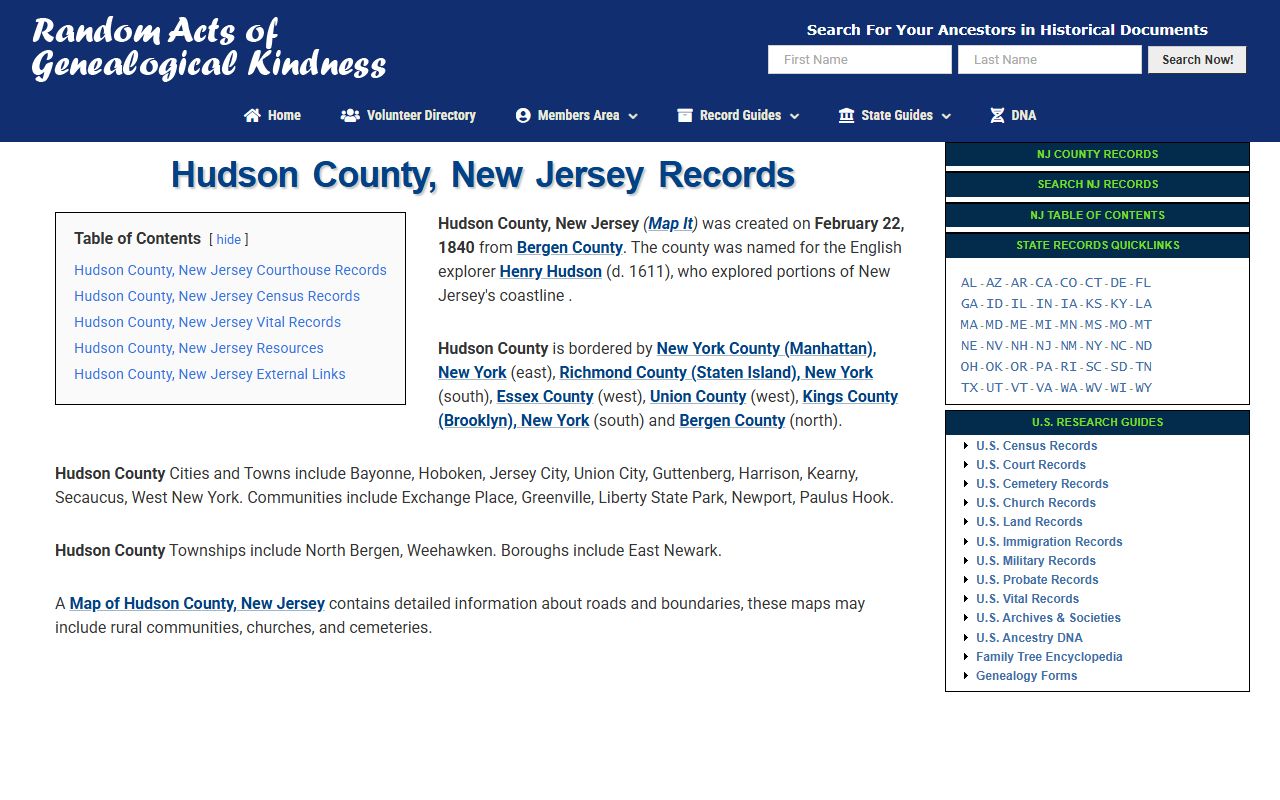
This page outlines how the clerk serves all 12 towns in Hudson County for vital record requests.
If you cannot find a death in the county index, try the state-level index. Some deaths were filed only at the state level, especially in the early 1900s. The NJ Office of Vital Statistics can help fill gaps in the Hudson County death index.
How to Order Death Records
Once you find a match in the death index, the next step is to get the full record. The death index gives you a name, date, town, and file number. That file number is the key. Use it when you contact the clerk or the state office. It speeds up the search and lowers the cost in some cases.
You can order from the Hudson County Clerk in person or by mail. In-person requests are handled at 257 Cornelison Ave, 4th Floor, Jersey City. Mail requests should include the full name, date of death, and your return address. Include a check for the fee. Call ahead to confirm the current fee amount.
The state office also fills requests. Write to the New Jersey Office of Vital Statistics, P.O. Box 370, Trenton, NJ 08625. Include the state file number from the death index. State copies cost $25 for the first copy. More copies ordered at the same time cost $2 each. Turnaround is usually a few weeks by mail.
- Gather the name, date, and file number from the death index
- Choose the county clerk or state office for your request
- Include payment with mail requests
- Allow several weeks for mail orders
Genealogy Research in Hudson County
Hudson County is a rich area for genealogy. Its ports and rail lines drew waves of immigrants from the 1840s onward. Irish, German, Italian, and Eastern European families all settled here. The death index captures many of these families as they aged and passed in the county.
The 1949 to 2017 block of the death index is the most complete. It covers nearly 70 years of deaths in Hudson County. For earlier research, pair the 1901 to 1903 and 1920 to 1929 blocks with census records, church files, and newspaper obituaries. The Jersey City Public Library has local history resources. The New Jersey State Archives in Trenton hold microfilm and digital copies of many vital record indexes.
Cross-reference the death index with other sources. A death record may list a birthplace. That can lead you to ship manifests or foreign records. Marriage records at the county clerk can fill in family links. Land records show where families lived. Probate files at the surrogate's office reveal assets and heirs. All of these are at or near the county seat in Jersey City.
Note: Some Hudson County death index entries have limited data for older years. Names may be abbreviated. Dates may show only the month and year. Use what you find as a lead, then seek the full record to confirm details.
Cities in Hudson County
All 12 municipalities in Hudson County are part of the countywide death index. Deaths in each town are filed with the county clerk in Jersey City. The links below lead to city-level pages with more local detail.
Other towns in Hudson County include East Newark, Guttenberg, Harrison, Kearny, Secaucus, and Weehawken. All deaths in these places appear in the Hudson County death index.
Nearby Counties
These counties border Hudson County. If a death occurred near a county line, check the neighboring county's death index as well. The place of death determines which county holds the record.