
Essex County Death Records
The Essex County death index covers records from 1901 through 2017. Essex County is one of the most populated counties in New Jersey with its seat in Newark. You can search the death index by name or year to find records from this county. The County Clerk at the Hall of Records in Newark holds local vital records. State sources give you more ways to search. This page shows where to look and how to get copies of death records in Essex County.
Essex County Quick Facts
Essex County Death Index Sources
Essex County was created in 1683 from East Jersey. It is one of the oldest counties in the state. The county seat is Newark, the largest city in New Jersey. The County Clerk is at the Hall of Records, 465 Martin Luther King Jr. Boulevard, Newark, NJ 07102. The Clerk holds marriage records from 1780 to 1930 and other vital records. The Surrogate is at the same address.
The free New Jersey Death Index has online records for Essex County from 1901 to 1903, 1920 to 1929, and 1949 to 2017. You can search by name to find a match. Each entry shows the name, date of death, and a reference number. This is an index, not the full death record. Once you find a match, you can order the actual certificate from the state.
The Reclaim The Records project obtained these index records through the Open Public Records Act. About 96,000 entries cover just 1901 to 1903 across all of New Jersey. Essex County, as the most populated county, has a large share of those records. The project makes all of its data free to search online.
The image below links to the Essex County Clerk resource page.
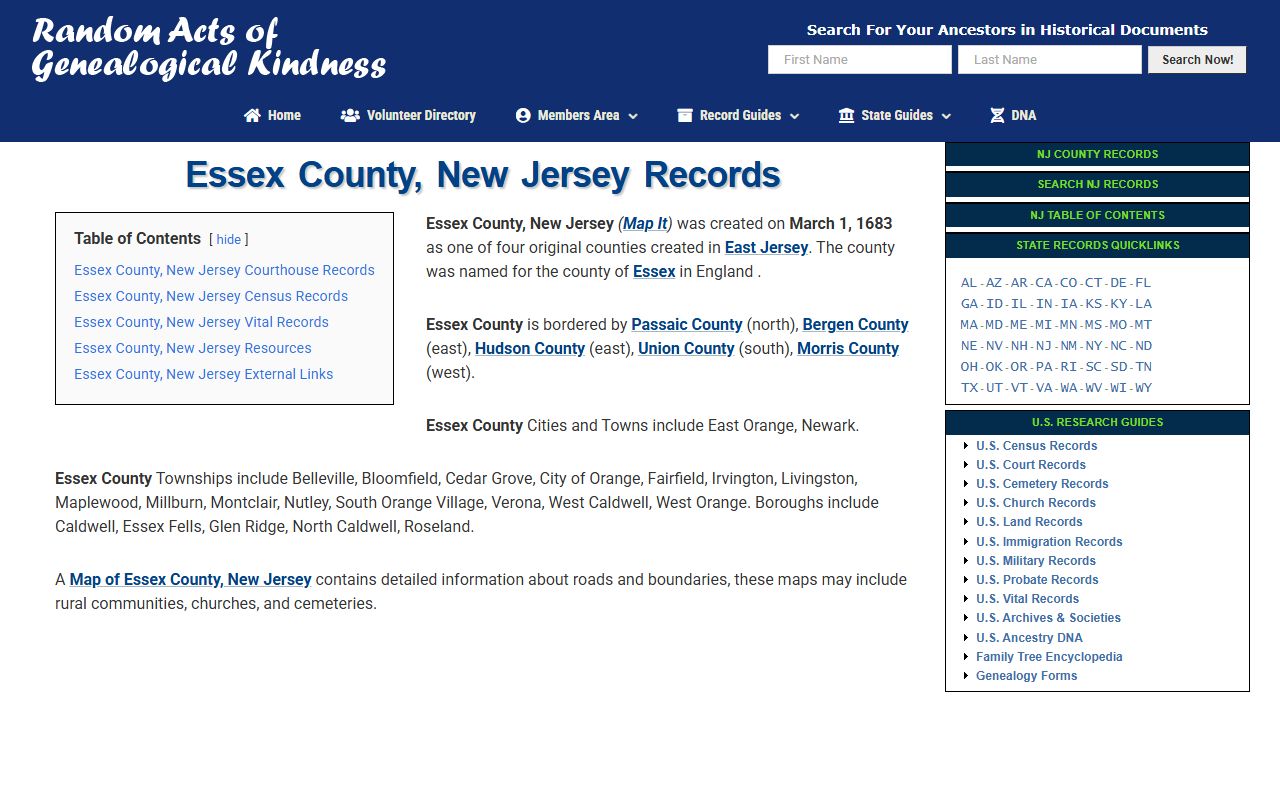
The County Clerk in Newark can help you find older vital records tied to Essex County.
Note: Caldwell Township has Birth and Death Returns from 1863 to 1864, which predate the state death index by decades.
How to Search Essex County Death Records
Start at newjerseydeathindex.com and type the name you need. You can search all of New Jersey or narrow results to Essex County. If the death took place in a covered year, the index should show it. Gaps exist for 1904 to 1919 and 1930 to 1948 because the state could not find those index files.
For deaths before 1901 in Essex County, the New Jersey State Archives is the best source. They hold death records on microfilm from 1848 to 1963. You can visit at 225 West State Street in Trenton. Their online databases have searchable entries. The Archives adds new records on a regular basis. Essex County death records make up a large part of the statewide collection because of the county's size.
The New Jersey Historical Society in Newark is another resource. They hold manuscripts, maps, and other papers that may include death notices, obituaries, and burial records from Essex County. Their collection spans hundreds of years.
You can also visit the Essex County Clerk in person at 465 MLK Jr. Boulevard in Newark. The Clerk has marriage records from 1780 to 1930. While these are not death records, marriage records can help you confirm names and dates that lead to a death record in Essex County.
Essex County Death Index Years
The death index for Essex County covers these year ranges:
- 1901 to 1903
- 1920 to 1929
- 1949 to 2017
The years 1904 to 1919 are missing from the index. The Department of Health could not find those files when they were requested. The years 1930 to 1948 are also absent. The actual death certificates may still exist on microfilm at the State Archives. If you need an Essex County death record from a missing year, contact the New Jersey Department of Health about their holdings.
For the 1920s, records are grouped in five-year blocks. They are sorted by county, then by year, then by last name. About half of the 1920 to 1924 block is missing for all counties, including Essex. The 1925 to 1929 block is more complete. Essex County had a large population during the 1920s, so the records from that decade are extensive for this area.
Note: Under N.J.S.A. Title 26, all local registrars in Essex County must register deaths and send originals to the State Registrar.
Essex County Death Certificates
A death certificate is the full record of a death in Essex County. It shows the name, date, place, and cause of death. It also lists parents' names. The doctor who certified the death and the funeral director who filed it both sign the form. A certified copy has a raised seal and is printed on state safety paper.
You can get a certified copy from the New Jersey Department of Health. The state charges $25 for the first search and one certified copy. Each extra copy costs $2 when ordered at the same time. Mail your request to P.O. Box 370, Trenton, NJ 08625-0370. You can also visit the walk-in center at 140 East Front Street in Trenton. Local registrars in Essex County towns also issue certified copies.
The image below links to the New Jersey Historical Society site.

The New Jersey Historical Society in Newark holds papers and records that may help you trace a death in Essex County.
Not everyone can get a certified copy. Under New Jersey law, only certain family members, legal representatives, or government agencies may receive one. For genealogical copies of death records older than 40 years, access rules are less strict. The cause of death and Social Security number may be hidden on those copies.
Death Records by Municipality
Essex County has 22 municipalities. Each one has a local registrar who keeps death records for that town. When a death happens in an Essex County town, the local registrar files the record and sends the original to the state. You can contact the town clerk to ask about death records.
The municipalities include Newark, East Orange, Montclair, Bloomfield, Irvington, Livingston, West Orange, Maplewood, South Orange, Nutley, Belleville, Glen Ridge, Verona, Cedar Grove, Essex Fells, Fairfield, North Caldwell, Caldwell, West Caldwell, Roseland, Millburn, and Orange. Newark is by far the largest. As the county seat and biggest city in the state, Newark generates a very large share of the death records in Essex County.
Essex County Death Index for Genealogy
The Essex County death index is a strong tool for family history research. Death records show parents' names, birthplaces, and last known addresses. For records before 1878, certificates list the names of parents, the exact date of death, and the age at death. Records from 1878 to 1900 may show parents' names on the certificate but not on the register.
FamilySearch has indexes for New Jersey deaths and burials from 1720 to 1988. Ancestry has a deaths and burials index for 1798 to 1971. The Reclaim The Records death index covers 1901 to 2017 with free access. The State Archives databases also have entries for Essex County death records. The Random Acts of Genealogical Kindness page for Essex County lists volunteers who may help with local lookups.
For deaths before 1848 in Essex County, no statewide civil records exist. Check church registers, family Bibles, cemetery records, or probate files. Essex County has churches in Newark and Orange whose records go back to the 1600s. The New Jersey Historical Society in Newark holds a large collection of manuscripts that may include death notices and burial records from early Essex County.
Note: Caldwell Township kept Birth and Death Returns for 1863 and 1864, a rare set of local records for that era in Essex County.
Cities in Essex County
Essex County has over 20 municipalities. All death records from these cities and towns are part of the county and state death indexes. Select a city below for more on local death records.
Other municipalities in Essex County include Montclair, Livingston, West Orange, Maplewood, South Orange, Nutley, and Belleville. All death records from these places appear in the Essex County death index.
Nearby Counties
These counties border Essex County. If you are not sure where a death was recorded, check each county. The death may have been filed across the county line if the person died at a hospital in a nearby area.